Summary: This article provides an in-depth exploration of the core value and market ecosystem of AI consulting companies in the Macao Special Administrative Region of China. It covers the definition of AI consulting services, the digital transformation challenges faced by Macau enterprises, specific application scenarios for AI solutions (such as omnichannel customer service, private knowledge bases, and process automation), and offers detailed implementation steps and cost-benefit analysis. Citing authoritative data from Gartner, IDC, and the Macao Statistics and Census Service, and combining it with localized case studies, this article aims to provide an objective, comprehensive, and practically valuable strategic guide for enterprises seeking "Macau AI consulting company" services.
The Rise and Market Background of Macau's AI Consulting Industry
With the advancement of the global digital economy wave, Artificial Intelligence (AI) has transformed from a cutting-edge technology into a key engine driving core enterprise competitiveness. In the Macao Special Administrative Region of China, the economic structure, heavily reliant on the gaming and tourism industries, is actively seeking diversified development. The application of AI technology has become a crucial breakthrough for enhancing service industry efficiency, optimizing operational processes, and creating new business models. Against this backdrop, professional "Macau AI consulting companies" have emerged, playing a bridging role between cutting-edge technology and local business practices.
The Intrinsic Drivers of Macau's Economic Digital Transformation
According to data from the Macao Statistics and Census Service, the service sector holds an absolute dominant position in the local Gross Domestic Product. However, facing multiple challenges such as rising labor costs, increasing demands for tourist experience, and intensifying international competition, enterprises have a growing and urgent need for cost reduction and efficiency improvement. Reports from international research firm IDC indicate that spending on AI solutions in the Asia-Pacific region (excluding Japan) will continue to grow at a high speed, with retail, tourism/hospitality, and financial services being key investment areas. This aligns highly with Macau's industrial structure. For enterprises, adopting AI is no longer merely a technical upgrade but a strategic choice concerning survival and development.
Definition and Core Value of AI Consulting Services
Unlike traditional IT system integrators, professional AI consulting companies provide full-cycle services encompassing strategic consulting, technology selection, implementation deployment, and continuous optimization. Their core value lies in:
- Lowering the Technical Barrier: Transforming complex AI technology into solutions for specific business problems, enabling non-technical decision-makers to clearly understand the return on investment.
- Mitigating Implementation Risks: Leveraging cross-industry project experience to help enterprises avoid common technical pitfalls and management misconceptions, ensuring project success.
- Achieving Sustained Value: AI models require continuous data feeding and tuning. Consulting services ensure solutions evolve with business development, rather than ending with a one-time delivery.
The Uniqueness of the Local Macau AI Consulting Market
The Macau market possesses significant uniqueness: multicultural integration (Chinese, Portuguese, and English used concurrently), a predominance of small and medium-sized enterprises (SMEs), extremely high requirements for data security and privacy (especially in finance and gaming-related industries), and a fast-paced business rhythm. This demands that a "Macau AI consulting company" not only possesses globally-minded technical capabilities but also a deep understanding of local regulations, business customs, and the multilingual environment. For example, an effective AI customer service solution must be able to fluently handle mixed queries in three languages and comply with the strict provisions of Macau's Personal Data Protection Law.
Analysis of Major AI Transformation Application Scenarios and Solutions for Enterprises
For Macau enterprises, the application of AI is not a distant concept but a practical tool that can be rapidly implemented to yield direct benefits. The following provides an in-depth analysis of three of the most common and high-return application scenarios.
Omnichannel Intelligent Customer Service: Enhancing Tourist and Customer Experience
In Macau, where tourism and retail are core industries, customer service quality directly impacts brand reputation and revenue. Traditional customer service models face pain points such as labor shortages, high costs for multilingual services, and untimely responses.
Technical Implementation Path and Benefits
Modern AI customer service systems, based on Natural Language Processing (NLP) and machine learning technologies, can integrate online channels like WhatsApp, WeChat, and websites to achieve 7x24 automated responses. According to industry practice, a mature AI customer service can handle approximately 80% of common, repetitive inquiries, such as business hours, product information, and booking status queries. This not only frees human agents from tedious work, allowing them to focus on handling complex complaints and value-added sales, but also ensures customers receive immediate responses at any time, significantly boosting satisfaction. During implementation, the key lies in building a high-quality dialogue corpus and establishing a smooth "AI cannot handle → transfer to human agent" process.
Localized Case Study: Practice of a High-End Retailer
A high-end retailer located in Macau's Cotai area, facing a large volume of pre-sales inquiries from international tourists, deployed an AI customer service supporting Chinese, English, and Portuguese. Three months after launch, the customer service team's average daily query processing volume increased by 35%, while the average customer wait time was reduced from 8 minutes to under 30 seconds. More importantly, the system could automatically identify conversations with high purchase intent and instantly push coupons, driving a 15% increase in the online inquiry conversion rate.
Enterprise Private Knowledge Base (RAG): Empowering Organizational Intelligence
Enterprises internally hold vast amounts of knowledge assets scattered across product manuals, SOPs, meeting minutes, contract documents, etc. Common problems include difficulty in training new employees, challenges in transferring veteran employee experience, and low efficiency in cross-departmental information queries.
How RAG Technology Works
Retrieval-Augmented Generation (RAG) is the mainstream technology for building enterprise knowledge bases today. Its principle is: first, vectorize various enterprise documents (PDFs, Word files, etc.) and store them in a private database; when an employee asks a question, the system first retrieves the most relevant text fragments from the database, then submits these fragments along with the question to a large language model to generate accurate, reliable answers. This approach leverages the powerful comprehension and generation capabilities of large models while ensuring answers are sourced from authoritative internal enterprise data, avoiding the risk of model "hallucination."
Implementation Keys and Value Measurement
The key to success lies in the quality of document preprocessing and the accuracy of the retrieval algorithm. After implementation, the most direct benefit is the leap in knowledge acquisition efficiency. For example, an engineer querying a solution for an equipment fault code can go from needing half an hour to sift through hundreds of PDF pages to getting an AI Q&A answer in just 10 seconds. According to a Forrester study, enterprises implementing RAG knowledge bases saw an average 25% reduction in employee time spent searching for information and collaborating. For many hotels or financial institutions in Macau that emphasize service standard consistency, this means stable and controllable service quality.
Business Process Automation: From Efficiency Optimization to Strategic Reshaping
Business Process Automation (combining RPA and AI) aims to liberate employees from repetitive, rule-based digital tasks such as data entry, report generation, and invoice processing.
Common Automation Scenario List
Macau enterprises can prioritize the following high-return automation scenarios:
- Finance & Accounting: Accounts receivable/payable reconciliation, invoice data extraction and verification, preliminary review of expense reimbursement documents.
- Human Resources: Resume screening and preliminary matching, new employee onboarding document processing, attendance data consolidation.
- Operations & Supply Chain: Inventory data synchronization and alerts, order status tracking and customer notification, supplier email information extraction.
- Marketing & Sales: Potential customer list screening and categorization, initial follow-up email sending for sales leads, social media data monitoring report generation.
Cost-Benefit Analysis Model
McKinsey reports show that about 60% of occupations have at least 30% of work activities that can be automated. For enterprises, the Return on Investment (ROI) for automation can be estimated using a simple model: ROI = (Annual Saved Labor Costs + Annual Loss Reduction from Fewer Errors + Annual Value from Efficiency Gains - Annual Software Licensing & Maintenance Costs) / Initial Implementation Cost. A typical Macau SME, after automating a core financial process, can usually recoup the investment within 12-18 months. The longer-term value lies in enabling the enterprise to redeploy valuable human resources to more creative and strategic work, as discussed in our article on Greater Bay Area Enterprise AI Transformation: Strategic Pathways and Practical Guide Driving Regional Economic Intelligent Upgrade, which is a foundational step for enterprises to achieve intelligent upgrade.
How to Choose the Right Macau AI Consulting Company: Evaluation Framework and Comparison
Faced with different service providers in the market, enterprises need a systematic evaluation framework to make informed decisions. The following key dimensions can serve as a reference.
Core Competency Assessment Dimensions
- Industry Knowledge & Local Understanding: Does the consultant have a deep understanding of the operational models, regulatory requirements, and challenges of Macau's specific industries like gaming, tourism, retail, and finance? Do they have multilingual project experience?
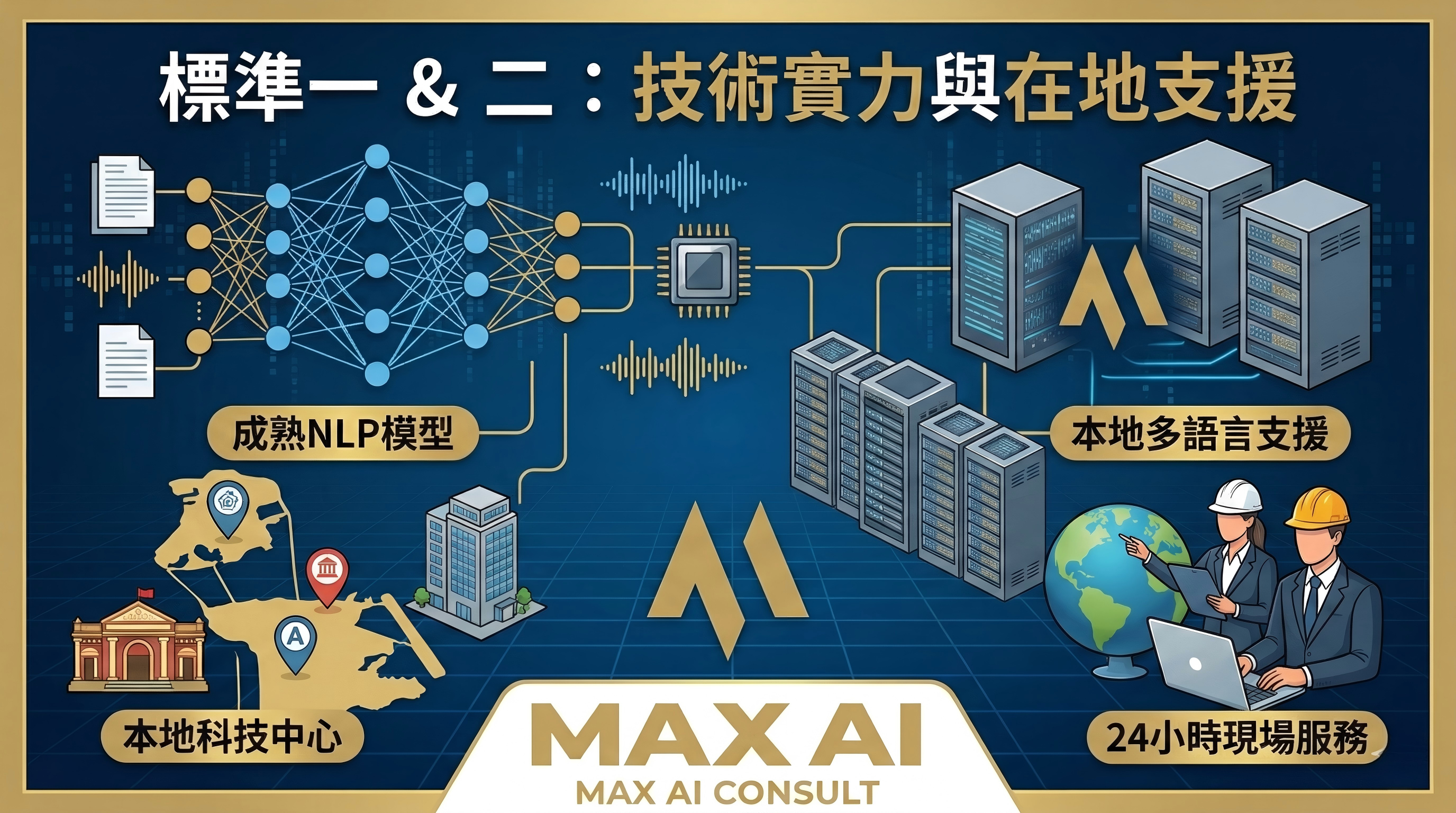
- Technical Capability & Certifications: Does the team hold relevant certifications from internationally leading technology platforms (e.g., NVIDIA, Microsoft Azure, AWS, Alibaba Cloud)? This relates to the technical advancement and stability of their solutions.
- Project Methodology & Implementation Experience: Do they have mature project management processes (e.g., Agile development)? Can they provide references for past successful cases in Macau or the Greater Bay Area?
- Data Security & Compliance: Do they insist on private deployment solutions? How do they guarantee absolute security of enterprise data during training and inference? What is their depth of understanding of Macau's Personal Data Protection Law?
- Service Model & Ongoing Support: Do they provide a one-time consulting report, or a full-stack service of "consulting-implementation-operation & maintenance"? How are post-launch model optimization and technical support conducted?
Comparison of Strengths and Weaknesses of Different Types of Service Providers
| Evaluation Dimension | International Large Tech Firms | General IT Integrators | Local-Focused AI Consulting Companies | | :--- | :--- | :--- | :--- | | Industry & Local Knowledge | Weak, typically offer standardized solutions | Average, focus on IT infrastructure | Very Strong, deep understanding of Macau's business & regulatory environment | | Solution Customization | Low, mainly cloud API services | Medium, requires longer development cycles | High, can be deeply customized for business processes | | Implementation & Communication Cost | High (often requires liaising with overseas teams) | Medium | Low, efficient communication with local team | | Data Security & Deployment | Mostly public cloud, data may leave the region | Depends on the project | Emphasizes private deployment, data stays local | | Ongoing Service & Response | Relies on standardized support channels | Depends on specific contract terms | Strong, provides tailored continuous optimization services | | Typical Pricing Model | Subscription fee (usage-based) | Project-based (man-day pricing) | Value-oriented, often linked to outcomes |
Practical Steps from Needs Definition to Vendor Screening
- Internal Diagnosis: Form a cross-departmental team to identify and prioritize 1-3 of the most valuable AI application scenarios, defining budget scope and expected goals (e.g., increase customer service efficiency by X%).
- Market Research: Conduct preliminary screening of 3-5 candidate service providers through industry associations, online searches (e.g., querying "Macau AI consulting company case studies").
- Request for Proposal (RFP): Prepare a detailed RFP containing company background, specific pain points, expected outcomes, technical requirements (e.g., language support, deployment method), and budget framework.
- Solution Evaluation & Demo: Invite candidate providers to propose solutions and conduct demos (Proof of Concept - POC), focusing on their depth of understanding of your needs, feasibility of the technical solution, and team professionalism.
- Reference Case Verification: Be sure to contact past clients provided by the service provider to understand actual implementation results, project management level, and after-sales service quality.
- Contract Negotiation: Clearly define project scope, delivery milestones, acceptance criteria, intellectual property ownership, confidentiality clauses, and subsequent maintenance responsibilities.
AI Transformation Project Implementation Roadmap and Risk Management
Successful AI projects are not just about technology; they involve a transformation encompassing processes, people, and culture. A clear implementation roadmap is crucial.
Four-Phase Implementation Roadmap
Phase 1: Strategy Planning & Proof of Concept (PoC) (1-2 Months)
- Goal: Verify technical feasibility and build internal consensus.
- Actions: Select a clearly scoped, easily measurable pain point with high value (e.g., "automatically respond to customer queries about Product A inventory") for a PoC. Work closely with the consulting team to quickly build a Minimum Viable Product (MVP).
- Outputs: PoC results report, preliminary business process redesign plan, core team training.
Phase 2: Pilot Deployment & Data Preparation (2-3 Months)
- Goal: Conduct a small-scale pilot within a single department or business line to refine the solution.
- Actions: Expand functionality and optimize stability based on the PoC. Systematically collect, clean, and label training data—the cornerstone of AI model performance. Simultaneously, develop a change management plan and train employees in the pilot department.
- Outputs: Stable pilot system, high-quality labeled dataset, user operation manual.
Phase 3: Full-Scale Rollout & Integration (3-6 Months)
- Goal: Replicate pilot success to other relevant departments and integrate with existing IT systems (e.g., ERP, CRM).
- Actions: Adjust the plan based on pilot feedback. Conduct large-scale user training and communication to manage change resistance. Establish a monitoring indicator system to continuously track the business impact of the AI application.
- Outputs: Enterprise-level AI application platform, system integration interfaces, complete operational management specifications.
Phase 4: Scaling & Continuous Optimization (Ongoing)
- Goal: Explore new application scenarios and establish an AI-driven innovation culture.
- Actions: Establish a dedicated AI Center of Excellence (CoE) responsible for daily model monitoring, iterative optimization, and new scenario exploration. Productize AI capabilities to empower more business units.
- Outputs: Evolving AI capability map, quantified business value reports, innovative business use cases.
Major Risks and Mitigation Strategies
- Data Quality Risk: Garbage in, garbage out. Mitigation: Invest resources in data governance early in the project to ensure training data accuracy, completeness, and representativeness.
- Business Integration Risk: Technology and business operate in silos; the solution cannot integrate into actual workflows. Mitigation: Ensure business departments are deeply involved from start to finish. Give business departments the authority to evaluate project success.
- Talent & Culture Risk: Employee resistance to change, lack of internal talent to operate AI systems. Mitigation: Conduct thorough communication and training, positioning AI as an "employee assistant" rather than a "replacement." Develop talent cultivation plans.
- Ethical & Compliance Risk: AI decisions may introduce bias or breach data privacy red lines. Mitigation: Introduce ethical review and compliance checks at the design stage to ensure system fairness, transparency, and explainability, strictly adhering to Macau's local laws and regulations. For a broader regional strategic perspective, refer to the relevant discussion in Greater Bay Area AI Consulting In-Depth Analysis: Strategic Guide, Implementation Pathways, and Future Trends for Enterprise Intelligent Transformation.
Future Trends of Macau's AI Industry and Enterprise Action Recommendations
Looking ahead, AI applications in Macau will continue to expand in depth and breadth, closely integrating with the Greater Bay Area's development strategy.
Forward-Looking Trend Insights
- From "Automation" to "Intelligent Decision-Making": Future AI will not only handle repetitive tasks but also assist mid-to-senior managers in market forecasting, risk assessment, and strategic planning. For example, using AI to analyze tourist consumption data to dynamically adjust hotel room rates and package recommendation strategies.
- Edge AI & Real-Time Processing: In scenarios like casino surveillance and large-scale event security management, the demand for low-latency, high-privacy real-time AI analysis is growing, driving the deployment of Edge AI devices.
- Convergence of AI with Metaverse/Digital Twins: To enhance tourist experience, Macau's tourist attractions and hotels may build digital twins, using AI-driven virtual characters to provide guided tours and interactive services, creating a new integrated online-offline experience.
- Responsible AI Becomes Standard: With strengthened regulation and increased public awareness, enterprises must be able to demonstrate the fairness, explainability, and safety of their AI systems. This will become a core threshold for selecting AI partners.
Action List for Macau Enterprises
Regardless of the stage of AI transformation an enterprise is in, the following actions can be taken immediately:
- Initiate Internal Education: Organize management and key employees to learn AI fundamentals and industry application cases to align understanding.
- Conduct a Free AI Diagnostic: Seek professional consultants offering free preliminary diagnostic services to objectively assess the enterprise's AI readiness and high-potential application points.
- Start Small, Achieve Quick Wins: Avoid creating large, long-term "AI Master Plans." Choose a pilot project that can be completed within 3-6 months with clear, visible returns to build confidence with success.
- Invest in Data Foundation: Start immediately to organize and standardize core business data, establishing data quality standards. Data is the "oil" for future AI competition.
- Cultivate Internal AI Champions: Designate or hire individuals with both business knowledge and technical understanding to act as "translators," bridging internal teams with the AI consulting company.
- Stay Open and Agile: AI technology iterates rapidly. Enterprises should maintain an open mindset and be willing to flexibly adjust their transformation path based on technological developments and pilot results.
Frequently Asked Questions
Q: Which AI consulting companies in Macau are trustworthy?
A: When selecting an AI consulting company in the Macao Special Administrative Region of China, enterprises should focus on several key dimensions: depth of understanding of Macau's local industries (e.g., tourism, retail, finance), experience in implementing multilingual (Chinese, English, Portuguese) projects, emphasis on data private deployment and security compliance, and whether they provide end-to-end services from consulting to implementation. It is recommended that enterprises obtain referral lists through industry associations and business networks, and request potential service providers to provide specific successful case studies in Macau or the Greater Bay Area for verification. A professional consulting team will first strive to understand your business pain points rather than directly selling standardized products.
Q: For SMEs in Macau, what should be the first step in AI transformation?
A: The most practical first step for Macau SMEs to initiate AI transformation is to conduct a systematic "AI Opportunity Scan." This does not require huge investment and can be led by management with core employees or assisted by professional consultants offering free preliminary diagnostics. The focus is to map out all daily work processes that are highly repetitive, rule-based, and document or data-driven (e.g., customer Q&A, order entry, report compilation), and from these, select one small-scoped but highly painful area with relatively accessible data as a pilot. The goal is to achieve a micro-project within a short timeframe (e.g., 3 months) that directly demonstrates efficiency gains or cost savings, thereby quickly validating value and building team confidence.
Q: Which has a lower long-term cost: deploying an AI customer service system or hiring human agents?
A: This requires a dynamic Total Cost of Ownership (TCO) analysis. Initially, an AI customer service system involves software licensing, customization, and implementation costs, which may represent a higher one-time investment. Human agents primarily incur labor salary costs. However, in the long term (e.g., 2-3 years), the marginal cost of an AI system is extremely low; one system can handle nearly unlimited concurrent inquiries without rest or turnover. Human agent costs continue to increase with salary raises and team expansion. For Macau retail or service industry enterprises with high inquiry volumes, AI customer service typically demonstrates cost advantages within 1-2 years. Additionally, AI can improve service consistency and customer satisfaction, value that is difficult to quantify but crucial.
Q: What is the typical fee structure for collaborating with a Macau AI consulting company?
A: Fees for professional AI consulting projects are usually not a single quote but composed of several parts: 1) Consulting & Design Fees: For business research, solution design, and process re-engineering; 2) Software Development & Licensing Fees: Including core AI engine and customized feature development costs; 3) Implementation & Deployment Fees: Covering system integration, data migration, testing, and go-live work; 4) Training & Change Management Fees: Ensuring employees can effectively use the new system; 5) Ongoing Maintenance & Optimization Fees: Usually in the form of an annual service fee for technical support, system upgrades, and model iteration. The fee model could be a fixed project price, time-and-materials (man-day), or an outcome-based sharing model. Enterprises should request service providers to provide a clear fee breakdown with corresponding value explanations.
Q: How can we ensure the solution designed by the AI consulting company truly meets the actual needs of our Macau enterprise?
A: The key to ensuring the solution fits reality lies in the enterprise's own deep involvement and clear acceptance criteria. First, before project kick-off, the enterprise should form a project team led by business departments with IT department support, clearly defining the specific problem to be solved and quantifiable success metrics (e.g., "reduce time to handle a certain type of customer request from 10 minutes to 1 minute"). Second, during the solution design phase, insist that the consultant conducts on-site research and process tracking, not just relying on meetings. Finally, adopt an Agile development model, breaking the project into multiple short cycles (e.g., two-week sprints). At the end of each sprint, deliver a demonstrable, testable functional module for business users to accept and provide feedback, ensuring the final product closely aligns with business needs.